How to Send Money Internationally for Less in 2026
Last reviewed: October 1, 2026
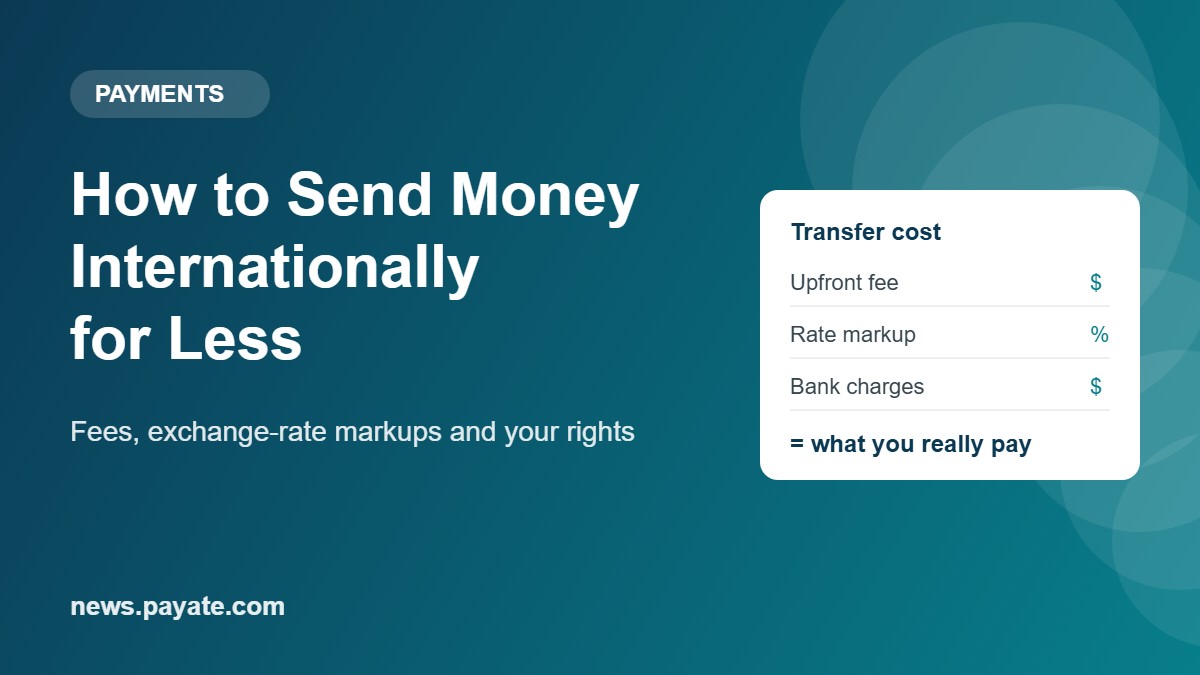
Short answer: To send money internationally for less, compare the amount the recipient will actually receive, not the advertised fee. The true cost of a transfer has three parts: the upfront fee, the exchange-rate markup hidden in the rate you are offered, and any fees taken by intermediary banks or the recipient's bank. The markup is often the largest part, and a "zero fee" transfer can still be expensive.
In most cases the cheapest route is a transfer paid from your bank account and delivered to the recipient's bank account or mobile wallet, booked online, without a rush. Paying by credit card, choosing cash pickup, and asking for instant delivery usually cost more. World Bank data shows banks are, on average, the most expensive type of provider for small transfers. Whichever service you use, check that it is regulated, keep the receipt, and never send money to someone you have not verified.
This guide explains how transfer pricing really works, how to measure the exchange-rate markup yourself, how the main transfer methods compare, and which legal protections apply in the United States, the United Kingdom and the European Union. It draws on the Consumer Financial Protection Bureau (CFPB), the Federal Trade Commission (FTC), the World Bank's Remittance Prices Worldwide database, the Financial Conduct Authority (FCA), the European Union's official portals, the European Central Bank (ECB), the IRS, FinCEN and the FDIC. We do not recommend or rank any provider, and we do not quote any company's current fees, because they change often.
This article is general information, not financial advice. Prices, rules and tax treatment differ by country, provider and personal situation.
In this guide
- The real cost of an international transfer
- The mid-market rate and how to measure markup yourself
- Transfer methods compared
- Speed vs cost: what you pay for urgency
- How funding and payout methods change the price
- What World Bank data says about transfer costs
- Your rights in the US: the Remittance Rule
- UK and EU protections
- Large transfers: property, tuition and forward contracts
- Tax and reporting basics
- Scams and fraud
- Common mistakes that make transfers expensive
- How to send money for less, step by step
- Sender's checklist
- FAQ
- Bottom line
- Sources
The real cost of an international transfer
The real cost of an international transfer is the difference between what you pay and what your recipient would have received if the whole amount had been converted at the true market exchange rate with no charges. It is made up of an upfront fee, an exchange-rate markup, and sometimes fees deducted by other banks along the way.
Most people look only at the first part, because it is the one printed in large type. That is a mistake. The World Bank, which tracks remittance prices around the world, measures cost as the sending fee plus the exchange-rate margin together. The United Nations uses the same definition for its Sustainable Development Goal indicator on remittance costs. If the official measure counts both, so should you.
Part 1: the upfront fee
The upfront fee is the visible charge for making the transfer. It may be a flat amount, a percentage of the amount sent, or a mix of both. Some providers charge different fees depending on how you pay, how the money is delivered and how fast it arrives.
Part 2: the exchange-rate markup
The exchange-rate markup is the gap between the true market rate and the less favourable rate the provider gives you. The provider keeps the difference. You never see it as a line called "fee." It simply means your recipient gets fewer units of their currency for each unit of yours.
This is why "no fee" and "zero commission" offers need a second look. A provider can charge nothing upfront and still earn a healthy margin through the rate. On larger amounts, the markup usually costs far more than any flat fee.
Part 3: intermediary and recipient bank fees
When a payment travels through the international banking network, it may pass through one or more intermediary (correspondent) banks before it reaches the recipient's bank. Each of them can deduct a charge from the money in transit. The recipient's own bank may also charge a fee for receiving a foreign payment.
These fees are the hardest to predict, because the sender's bank does not always control them. They are most common with traditional bank wires. If you are sending a bank wire, our guide to SWIFT codes vs IBANs explains how those payments are routed and which details you need, so we will not repeat that here.
A worked example (illustrative only)
The numbers below are invented to show the arithmetic. They are not real quotes, real exchange rates or any company's actual prices. Assume you want to send 1,000 US dollars to a relative who is paid in euros, and that the mid-market rate at that moment is 1 USD = 0.9000 EUR.
| Illustrative option | Upfront fee | Rate offered | Other deductions | You pay | Recipient gets | True cost |
|---|---|---|---|---|---|---|
| A. Traditional bank wire | $40 | 0.8730 (3.0% markup) | $15 intermediary fee and 10 EUR recipient bank fee | $1,040 | 849.91 EUR | About $95.66, or 9.2% of what you paid |
| B. Online provider, paid by bank debit | $6 | 0.8946 (0.6% markup) | None | $1,006 | 894.60 EUR | $12.00, or about 1.2% |
| C. "Zero fee" provider | $0 | 0.8775 (2.5% markup) | None | $1,000 | 877.50 EUR | $25.00, or 2.5% |
| D. Same as B, but paid by credit card | $6 plus a $30 card funding fee | 0.8946 (0.6% markup) | Your card issuer may add its own charges | $1,036 | 894.60 EUR | $42.00, or about 4.1%, before any issuer charges |
Here is how option A is calculated. The intermediary bank takes $15, so $985 is converted. At 0.8730, that is 859.91 EUR. The recipient's bank takes 10 EUR, leaving 849.91 EUR. At the mid-market rate, 849.91 EUR is worth about $944.34. You paid $1,040, so the transfer cost you about $95.66.
Three lessons come out of this illustration:
- The "zero fee" option was not the cheapest. Option C charged nothing upfront and still cost twice as much as option B, because of the rate.
- The biggest fee was not the biggest cost in every case. In option A, the markup, the intermediary fee and the recipient fee together cost more than the $40 wire fee.
- How you pay matters. Options B and D use the same provider and the same rate, yet D costs more than three times as much because of the card.
The simplest way to capture all of this is to ask every provider one question: "If I pay this exact amount in total, how much will arrive in the recipient's currency, after all fees?" Then pick the offer where the most arrives.
The mid-market rate and how to measure markup yourself
The mid-market rate is the midpoint between the price at which banks buy a currency and the price at which they sell it on the wholesale market. It is the fairest reference point for judging a quote, and you can measure any provider's markup against it with one line of arithmetic.
How to find a reference rate
- Use an independent source, not the provider's own converter. Central banks publish reference rates. The ECB, for example, publishes euro foreign exchange reference rates, and EU law uses those rates as the benchmark for card conversion disclosures.
- Check the rate at the same time as you collect quotes. Exchange rates move all day, so a reference rate from yesterday is only a rough guide.
The markup formula
Markup (%) = (mid-market rate minus rate offered) divided by mid-market rate, multiplied by 100.
Using the illustrative numbers from the example above: the mid-market rate is 0.9000 and the bank offers 0.8730. The difference is 0.0270. Divide by 0.9000 and you get 0.03, or a 3.0% markup. On $1,000, that is roughly $30 of cost that never appears as a fee.
The shortcut: compare the amount received
You do not have to calculate markups if you do not want to. Fix the total you will pay, including every fee, and compare the amount each provider promises to deliver. The highest delivered amount is the cheapest transfer. This single comparison automatically includes the fee and the markup.
The same hidden-markup problem appears when you pay by card abroad and a shop or cash machine offers to convert the amount into your home currency. Our guide to foreign transaction fees and dynamic currency conversion covers that situation.
Transfer methods compared
There is no single cheapest method for every transfer, but there is a clear pattern: account-to-account transfers booked online tend to cost least, while bank wires for small amounts, cash services and card-funded transfers tend to cost most. The right choice depends on the amount, the destination, how the recipient wants to be paid and how fast the money is needed.
Bank wire transfers
The CFPB describes a wire transfer as a common way to electronically move money from one bank account to another, either within the country or internationally. An international wire sent by a consumer from the US through a remittance transfer provider counts as a remittance transfer and carries specific federal protections.
Online money transfer providers
These are non-bank companies that move money through websites and apps. Many hold local accounts in several countries, so your money is paid in locally at one end and paid out locally at the other. That can avoid some correspondent bank charges.
They often show the fee and the rate upfront and are often cheaper than banks for small and medium amounts. They are not all alike, though. Some charge low fees and a thin margin, others advertise no fee and take a wider margin. We compare three well-known services in detail in Wise vs PayPal vs Payoneer, so this guide stays general.
Cash pickup services
Cash transfer services let you pay in cash or online and let the recipient collect cash from an agent location, often within minutes. They reach people who have no bank account, which is the reason they remain essential in many countries.
The convenience has a price. Agent networks are expensive to run, and cash services often cost more than account-to-account transfers. They also carry the highest fraud risk, because cash collected by a stranger is almost impossible to recover. The FTC puts it bluntly: wiring money through these services is like sending cash, and once you send it you usually cannot get it back.
Debit and credit cards
Cards appear in transfers in two ways. You can use a card to fund a transfer with a provider, or the money can be delivered to the recipient's card. Card funding is fast, which is why many services offer it.
Debit cards are often priced close to bank payments. Credit cards usually are not. Providers commonly add a surcharge for credit cards, and your card issuer may treat the payment as a cash advance, with its own fee and interest from the first day. Check your card agreement before you use a credit card to send money.
Mobile wallets and mobile money
In many countries people hold money in a mobile wallet linked to a phone number instead of, or as well as, a bank account. Transfers to mobile wallets can be fast and low-cost, and they suit small, regular payments.
Crypto transfers: important caveats
Sending cryptocurrency across borders can look cheap, but the full cost and the risks are easy to underestimate. Unless the recipient wants to hold crypto, there is a cost to buy it at one end and a cost to sell it at the other, plus network fees and any price movement in between.
The protections are also much weaker. The FTC notes that credit and debit cards have legal protections if something goes wrong, while cryptocurrencies typically do not, and that crypto payments typically are not reversible: you can usually get your money back only if the person you paid sends it back. The FDIC explains that deposit insurance covers certain deposit products at insured banks, such as checking and savings accounts, and applies only when a bank fails. Crypto is not a deposit. For the warning signs, see our guide on how to spot a crypto scam.
Side-by-side comparison
This table is qualitative. Real prices vary by provider, corridor and amount.
| Method | Typical cost level | Typical speed | Best for | Main drawback |
|---|---|---|---|---|
| Bank wire | High for small amounts; can be reasonable for large ones | Same day to several business days | Large payments, payments to businesses, places other services do not reach | Flat fees, rate markup and possible intermediary deductions |
| Online transfer provider (bank to bank) | Often low to moderate | Minutes to a few business days | Small and medium regular transfers | Limits on amounts and corridors; pricing models differ |
| Cash pickup | Moderate to high | Often minutes | Recipients without bank accounts; emergencies | Higher cost and high fraud risk |
| Card-funded transfer | Moderate with debit; high with credit | Often minutes | Urgent transfers when a bank payment is too slow | Surcharges and possible cash advance charges |
| Mobile wallet payout | Often low to moderate | Often minutes | Small payments where mobile money is common | Wallet limits and cash-out fees for the recipient |
| Crypto | Unpredictable once conversion costs are included | Minutes to hours | People who already use crypto at both ends | Price swings, irreversible payments, weak legal protection |
Speed vs cost: what you pay for urgency
Faster delivery usually costs more, and the cheapest transfers are normally the ones you can plan a few days ahead. If the money is not needed today, choosing a standard-speed option is one of the easiest savings available.
There are exceptions. Within the Single Euro Payments Area, the ECB describes an instant credit transfer scheme in which funds are delivered within ten seconds of the payment being authorised. Fast does not have to mean expensive where modern payment systems exist at both ends.
In the US, the receipt for a remittance transfer must show the date the money will be available, which lets you compare delivery promises on equal terms. Late delivery beyond that disclosed date is one of the errors you can ask the provider to resolve.
How funding and payout methods change the price
The same provider can charge very different prices for the same transfer depending on how you pay and how the recipient collects. As a rule, paying from a bank account and delivering to a bank account or wallet is cheapest, while paying by credit card or in cash and collecting in cash is dearest.
Funding methods
| How you pay | Cost tendency | Speed | Watch for |
|---|---|---|---|
| Bank account debit or bank transfer | Usually the lowest | Can add one or more days | Your own bank's fee if you fund by domestic wire |
| Debit card | Low to moderate | Fast | Possible small surcharge |
| Credit card | Often the highest | Fast | Provider surcharge, possible cash advance fee and immediate interest from your issuer |
| Cash at an agent | Moderate to high | Fast | Counter rates may differ from online rates |
The World Bank's findings change from quarter to quarter on this point, which is a reminder to check rather than assume. In its June 2024 report, covering the second quarter of 2024, it found that a credit or debit card was the lowest-cost instrument for originating remittances in its data set. That reflects the services it sampled, many of which are digital. It does not mean your credit card issuer will not add its own charges.
Payout methods
- Bank deposit. Often the cheapest and safest, with a clear record. The recipient needs an account, and their bank may charge to receive foreign payments.
- Mobile wallet. Often cheap and fast. In the same June 2024 report, the World Bank found that a debit card had overtaken the mobile wallet as the lowest-cost instrument for receiving remittances, with both among the cheaper options.
- Cash pickup. Convenient and fast, usually dearer, and risky if you do not know the recipient well.
Other choices that move the price
- Which currency you send. If you send your home currency and let the recipient's bank convert it, that bank sets the rate, and you cannot see it in advance. Sending in the recipient's currency lets you compare the rate before you pay.
- Who pays the bank charges. Bank wires may let you choose whether the sender, the recipient or both share the charges. If the recipient must get an exact amount, such as a tuition invoice, ask how to make sure nothing is deducted on the way.
What World Bank data says about transfer costs
World Bank data shows that sending a small amount abroad costs, on average, a little over 6% of the amount sent, that banks are the most expensive type of provider, and that digital services are cheaper than the overall average. Those averages hide a wide spread, which is exactly why comparing pays off.
The source is Remittance Prices Worldwide (RPW), a database the World Bank launched in September 2008. According to the World Bank's data catalog, it tracks the cost of sending relatively small amounts of money from one country to another, is updated quarterly, and covers 377 corridors across 48 sending countries and 111 receiving countries, with data running through the third quarter of 2025. The cost measure combines the sending fee and the exchange-rate margin.
Key findings from the June 2024 report
The RPW report we were able to read in full is Issue 50, published in June 2024 and covering the second quarter of 2024. Its key findings were:
| Measure (Q2 2024) | World Bank figure | What it means for you |
|---|---|---|
| Global average cost | 6.65% (up from 6.35% in Q1 2024) | The typical cost of a small transfer, fee and markup combined |
| Digital remittances index | 5.29% | Digital services were cheaper than the overall average |
| Banks | 13.40% | Banks were the most expensive provider type, about double the average |
| SmaRT average | 3.54% | The cost a well-informed sender could reach by choosing among the cheapest suitable services |
| Cheapest receiving region | South Asia, 5.53% | High-volume, competitive corridors cost less |
| Most expensive receiving region | Sub-Saharan Africa, 8.37% | Some regions still pay far more |
The most useful line in that table is the SmaRT average. The gap between 6.65% and 3.54% is, in effect, the reward for shopping around. The average sender paid nearly twice what an informed sender could have paid.
More recent headline figures
The World Bank publishes a new issue every quarter. Check the Remittance Prices Worldwide site for the latest figures, because they move.
The 3% target
The international goal is a global average of 3%. The RPW report describes this as a G20 commitment, and United Nations Sustainable Development Goal target 10.c sets the same ambition for 2030. On the World Bank's own numbers, the world is still paying roughly double that target.
Your rights in the US: the Remittance Rule
If you send more than $15 from the United States to a person or company abroad through a covered provider, federal law gives you the right to see the full price before you pay, to cancel within 30 minutes in most cases, and to have errors investigated and fixed. These protections come from the Remittance Rule, which is part of Regulation E and is enforced by the CFPB.
Who and what is covered
The CFPB defines a remittance transfer as an electronic transfer of more than $15 sent by consumers in the United States to people or companies in foreign countries. It covers banks, credit unions and money transfer companies that provide these transfers in the normal course of business. Under the regulation, a company that provided 500 or fewer remittance transfers in the previous calendar year, and provides 500 or fewer in the current year, is not treated as a remittance transfer provider.
The rule protects consumers sending money for personal, family or household purposes. It does not cover business payments.
What you must be told before you pay
Before you pay, the provider must give you a disclosure showing:
- the total cost of the transfer, including taxes and fees;
- the exchange rate, if one applies;
- the total amount expected to be delivered to the recipient.
The CFPB points out that this lets you shop around and compare costs with other companies. That is the practical value of the rule for saving money: you are entitled to the numbers before you commit. Some figures may be given as estimates if they are clearly labelled, and certain fees charged by the recipient's institution and foreign taxes may fall outside what the provider controls.
What the receipt must show
After you pay, you get a receipt that repeats the pricing information and adds the date the money will be available, instructions on what to do if there is an error, how to cancel, and contact details for complaints, including the CFPB. Keep it. It is your evidence if something goes wrong.
The 30-minute cancellation right
You can generally cancel a remittance transfer for a full refund within 30 minutes of paying, as long as the money has not already been picked up by the recipient or deposited into their account. Under the regulation, the provider must refund the total amount you paid, including fees and, where the law allows, taxes, within three business days of your cancellation request.
Error resolution
| Step | Deadline under the rule |
|---|---|
| You report the error to the provider | No later than 180 days after the disclosed date of availability |
| Provider investigates and decides whether an error occurred | Within 90 days of receiving your notice |
| Provider reports the results to you | Within three business days of completing the investigation |
| Provider corrects the error | Within one business day of receiving your instructions on the remedy, or as soon as reasonably practicable |
Errors under the rule include being charged a different amount from the one disclosed, computational mistakes by the provider, the recipient receiving less than the amount disclosed (with some exceptions), and the money not being available by the disclosed date (also with exceptions, for example where the sender gave an incorrect account number).
If an error occurred, you can generally choose between a refund of the amount that was not properly delivered and having the money sent again at no extra cost. If the provider does not resolve the problem, you can submit a complaint to the CFPB.
Money transfer companies in the US must also register with FinCEN as money services businesses, and FinCEN offers a public registrant search. Registration is a filing requirement. It is not a recommendation or an endorsement of the business.
UK and EU protections
In the UK, non-bank payment firms must be authorised or registered with the FCA, and most must keep customer money separate through safeguarding. In the EU, cross-border payments in euros must cost the same as equivalent domestic payments, and SEPA makes euro transfers across 41 European countries work like local ones.
UK: authorised and registered firms
The FCA states that all non-bank payment service providers must be authorised or registered with it. These include authorised payment institutions (APIs), electronic money institutions (EMIs) and small payment institutions (SPIs).
Before you use a firm, the FCA advises checking its Financial Services Register to make sure the provider is authorised and has permission for the service it is offering you. Brand names can differ from the registered company name, so look for the legal entity named in the terms and conditions.
UK: safeguarding is not the same as deposit protection
This is the point most people miss. The FCA says plainly that if your non-bank payment provider goes out of business, your money will not be protected by the Financial Services Compensation Scheme (FSCS).
Instead, EMIs and APIs must safeguard customer funds. They must either place your money in a separate safeguarding account with a bank or protect it with an insurance policy or similar guarantee. Small payment institutions are not required to safeguard in this way.
If a safeguarding firm fails, you would claim through the administrator or liquidator. The FCA warns that getting money back may take time and you may not receive all of it. The practical takeaway: use these services to move money, not to store large balances for long periods.
EU: equal charges for euro payments
Under EU rules on cross-border payments (Regulation (EU) 2021/1230), a payment service provider must charge the same for a cross-border payment in euros as it charges for a corresponding domestic payment of the same value. The EU's official Your Europe portal explains that banks in EU countries outside the euro area must apply this too: they may not charge more for a euro payment to or within another EU country than for a domestic payment in their national currency.
The limit of this rule matters for anyone trying to save money. Equal charges apply to the transfer fee, not to currency conversion. If your account is in one currency and the payment is in another, a conversion margin can still apply, so the markup check from earlier in this guide remains essential.
EU: conversion transparency and other rights
- When you pay by card in another EU currency, you must be told the amount of any currency conversion fees before you agree to the transaction. The regulation expresses card conversion charges as a percentage mark-up over the latest ECB reference rate, which makes offers comparable.
- Your payment provider must reply in writing to a complaint within 15 days, or up to 35 days in exceptional circumstances.
- For unauthorised payments, Your Europe states that your liability is limited to a maximum of 50 euros, and you are not liable at all if you could not have been aware of the loss or theft.
SEPA
The Single Euro Payments Area lets people make cashless euro payments across participating countries as easily as at home. The ECB reports that SEPA covers 41 European countries as of May 2025, including EU member states and several non-EU countries. It offers credit transfers, instant credit transfers that deliver funds within ten seconds, and direct debits.
If both you and the recipient have euro accounts inside SEPA, a SEPA credit transfer is normally the cheapest and simplest way to pay. You only need the recipient's IBAN. A more expensive international wire is usually unnecessary.
Large transfers: property, tuition and forward contracts
For large transfers, the exchange rate matters far more than the fee, so the way to save is to compare rates on the exact amount, verify the firm and the recipient details carefully, and decide in advance how to handle exchange-rate risk. On a large sum, a small percentage difference becomes real money.
A simple illustration, with invented numbers: on a 200,000 transfer, a 1% difference in the exchange rate is 2,000. A 30 or 40 fee is trivial next to that. This is the reverse of small transfers, where flat fees dominate.
How large transfers differ
- Rates may be negotiable. Banks and currency brokers sometimes improve the rate for large amounts. Ask for a firm quote on your exact amount, and get more than one.
- Expect questions. Providers must carry out identity and anti-money-laundering checks. Have proof of the source of funds ready, such as a sale agreement, bank statements or a loan letter. Supplying it early avoids delays.
- Safety outranks price. Check the firm's authorisation and how your money is protected while it is in transit. Remember that safeguarded funds are not covered by deposit guarantee schemes.
- Do not split payments to stay under reporting thresholds. Deliberately breaking up transactions to avoid reporting can itself be illegal. Legitimate transfers have nothing to fear from routine reporting.
Paying tuition abroad
Universities usually need an exact amount by a fixed date. If fees are deducted in transit, the payment arrives short and the student may face a late charge. Ask the university which payment methods it accepts, send in the invoice currency, and choose the charge option that delivers the full amount. Our guide on how to pay for studying abroad looks at the wider budget.
Buying property abroad
Property purchases combine a large amount, a deadline and a rate that can move between agreeing the price and completing the purchase. They are also a target for criminals who intercept emails and send fake payment instructions. Always confirm bank details by phoning the lawyer or agent on a number you already trust, never the one in the email. Consider sending a small test payment first and confirming it arrived.
Forward contracts: the basics
A forward contract is an agreement to exchange a set amount of currency at a rate fixed today, on a date in the future. People use them when they know they must pay a foreign-currency amount later, such as a property completion in three months, and want certainty about the cost.
- What you gain. You know exactly what the payment will cost in your own currency, whatever the market does.
- What you give up. If the rate moves in your favour, you do not benefit. You are still bound to the agreed rate.
- It is a commitment. If your purchase falls through, you may have to pay to close out the contract.
Tax and reporting basics
Sending money abroad is not, by itself, usually a taxable event, but large gifts, foreign accounts and business payments can trigger reporting duties. In the United States, the main ones to know are IRS Form 3520 for large gifts received from foreign persons, the FBAR for foreign accounts, and the gift tax rules for donors. Rules vary by country and situation, so treat this as orientation only.
Receiving a large gift from abroad (US)
The IRS states that a US person must report gifts or bequests from a nonresident alien individual or a foreign estate on Form 3520 if the aggregate amount received from that person or estate exceeds $100,000 during the tax year. A much lower threshold applies to gifts from foreign corporations or foreign partnerships: $20,116 for 2025 and $20,573 for 2026, adjusted each year for inflation.
Form 3520 is an information return, not a tax bill. But the penalty for ignoring it is severe. The IRS says it can charge 5% of the value of the gift for each month it goes unreported, up to 25%, unless you show reasonable cause. The form is generally due on the 15th day of the fourth month after the end of your tax year, which is April 15 for most individuals.
Sending a gift from the US
According to the IRS, the donor is generally the one responsible for paying any gift tax, not the recipient. The annual exclusion is $19,000 per recipient for both 2025 and 2026. Gifts above the annual exclusion are reported on Form 709. Reporting a gift does not necessarily mean tax is due, but the details depend on your circumstances and are worth checking with a tax professional.
Foreign bank accounts (US)
If you are a US person with a financial interest in, or signature authority over, foreign financial accounts, you must file a Report of Foreign Bank and Financial Accounts (FBAR) when the aggregate value of those accounts exceeds $10,000 at any time during the calendar year. The FBAR is filed electronically with FinCEN on FinCEN Form 114, not with your tax return. It is due April 15, with an automatic extension to October 15.
Everywhere else
- Many countries tax gifts or inheritances on the recipient's side, with their own thresholds.
- Money sent as payment for work or goods is income to the recipient and may be taxable. Freelancers can read our guide on how to get paid by international clients.
Keep records of every large transfer: the receipt, the purpose and the source of the money. If the amounts are significant, a short conversation with a qualified tax adviser in each country costs far less than a penalty.
Scams and fraud
The most expensive transfer is the one sent to a criminal, because that money is rarely recovered. The FTC's core rule is simple: never wire money to someone you have not met in person, to anyone claiming to be from a government agency or a well-known company, or to anyone who pressures you to pay immediately or insists that a wire is the only way to pay.
Scammers like money transfers for a reason. The FTC explains that once you wire money, there is usually no way to get it back, and the money can be picked up quickly at locations around the world. In a July 2026 consumer alert, the FTC said people reported the largest losses to scams, more than $4 billion in total, when they paid by bank transfer or cryptocurrency in the previous year. It listed bank transfers, wire transfers, cryptocurrency, payment apps and gift cards as the payment methods scammers push.
Scams the FTC warns about
| Scam | How it works | What to do |
|---|---|---|
| Family emergency | A caller pretends to be a relative or friend in urgent trouble. The FTC notes scammers now use voice cloning to sound real. | Hang up and call the person on a number you know |
| Romance | A fake online profile builds a relationship, then invents an emergency and asks for money | Never send money to someone you have not met in person |
| Fake check or overpayment | You are sent a check, told to deposit it and wire part of it back. The check later bounces. | Never send money back from a check you were asked to deposit |
| Utility or government threat | A caller threatens to cut off service or take legal action unless you pay at once | Contact the organisation using details from its official website or your bill |
If you have already sent money to a scammer
- Money transfer company. Contact the company immediately, say the transfer was fraudulent and ask for it to be reversed. The FTC publishes fraud phone lines for the major wire transfer companies on its website.
- Bank transfer. Contact your bank or credit union right away and ask for the payment to be reversed.
- Credit or debit card. Report it to the issuer immediately. Cards carry legal protections that other methods lack.
- Report it. In the US, report to the FTC at ReportFraud.ftc.gov. Elsewhere, report to your national fraud reporting service and the police.
Speed matters. If the money has not yet been collected, a transfer can sometimes be stopped. Beware of "recovery" services that contact you afterwards and promise to get your money back for an upfront fee. That is often a second scam.
Common mistakes that make transfers expensive
Most overpaying comes from a handful of habits: comparing fees instead of delivered amounts, defaulting to your own bank, paying by credit card, and leaving the transfer to the last minute. Fixing those four habits captures most of the available savings.
- Trusting "zero fee" or "0% commission." The cost has simply moved into the exchange rate.
- Using your bank out of habit. World Bank data consistently shows banks as the most expensive provider type for small transfers. Your bank may still be fine for a large or complex payment, but compare first.
- Paying with a credit card. Surcharges and possible cash advance charges can outweigh everything else.
- Using an unregulated service to save a little. Informal channels may be cheap, but you have no rights if the money disappears.
How to send money for less, step by step
- Decide the fixed number. Either the recipient needs an exact amount (a bill or invoice), or you have a set budget to send. This decides how you compare quotes.
- Ask how the recipient wants to be paid. Bank account, mobile wallet or cash. This narrows your options and affects the price.
- Collect and confirm the recipient's details. Full name exactly as on the account or ID, account number or IBAN, bank identifier, wallet number, address if required. Read them back.
- Look up the mid-market rate from an independent source at the time you compare.
- Get at least three quotes for the same amount, same payout method and same speed. In the US you are entitled to the pre-payment disclosure before you pay.
- Compare the amount delivered for the same total paid. Work out the markup if you want to see where the cost sits.
- Choose the slowest speed that still meets your deadline.
- Verify the provider. Check the FCA Register in the UK, your state regulator and the FinCEN registrant search in the US, or the national regulator elsewhere.
- Verify the recipient if they are new to you or if the bank details have changed. For a large amount, send a small test payment first.
- Pay and save the receipt and reference number.
- If you made a mistake, act within 30 minutes. In the US, that is your window to cancel for a full refund if the money has not been collected.
- Confirm arrival and ask the recipient exactly how much they received. Compare it with the amount promised.
- If the amount is short or late, report it promptly to the provider in writing and keep copies.
Sender's checklist
- I compared the amount the recipient will receive, not just the fee.
- I checked the offered rate against an independent mid-market rate.
- I got quotes from at least three providers for the same amount, payout method and speed.
- I am paying from a bank account or debit card, not a credit card, unless I have checked the extra cost.
- I chose standard speed unless the money is truly urgent.
- I am sending in the recipient's currency, or I know who will convert it and at what rate.
- The provider is authorised, registered or licensed where I live, and I checked this myself.
- I know the recipient personally, or I have verified them and their bank details through a trusted channel.
FAQ
What is the cheapest way to send money internationally?
For most small and medium transfers, the cheapest way is an online account-to-account transfer: paid from your bank account, delivered to the recipient's bank account or mobile wallet, at standard speed. No single provider is cheapest everywhere, so compare the amount delivered across at least three services for your specific country pair and amount.
How do I know if I am getting a good exchange rate?
Look up the mid-market rate from an independent source and compare it with the rate you are offered. Subtract the offered rate from the mid-market rate, divide by the mid-market rate and multiply by 100. The result is the markup as a percentage. The smaller the markup, the better the rate. Then add the fee to see the total cost.
Are "zero fee" international transfers really free?
Usually not. A provider that charges no upfront fee normally earns its money through the exchange rate, by giving you a rate below the mid-market rate. The transfer can still be good value, but you can only tell by comparing the amount the recipient will receive with other quotes.
Why is my bank more expensive than a money transfer app?
Banks often combine a flat wire fee with an exchange-rate markup, and the payment may pass through intermediary banks that deduct their own charges. Online providers frequently use local accounts at both ends and have lower costs. World Bank data for the second quarter of 2024 put the average cost of sending through banks at 13.40%, against a global average of 6.65%.
How much does it cost to send $200 or $1,000 abroad?
It depends on the corridor and the method. The World Bank measures costs at a $200 benchmark and reported a global average of 6.65% for the second quarter of 2024, which would be about $13.30 on $200. Many digital services cost less, and banks often cost more. Percentage costs usually fall as the amount rises, because flat fees are spread over more money.
Can I cancel an international money transfer after I send it?
In the US, you can generally cancel a remittance transfer within 30 minutes of paying and get a full refund, as long as the money has not been picked up or deposited. The provider must refund you within three business days of your request. Elsewhere, cancellation depends on the provider's terms and whether the payment has already been processed. Contact the provider at once.
What happens if the money never arrives or the amount is wrong?
Report it to the provider straight away with your receipt. Under the US Remittance Rule, you have 180 days from the disclosed availability date to report an error, and the provider has 90 days to investigate. If there was an error, you can generally choose a refund or have the money resent at no extra cost. In the UK, you can escalate to the Financial Ombudsman Service.
Is my money protected if the transfer company goes bust?
Not in the same way as a bank deposit. In the UK, the FCA says money with a non-bank payment provider is not covered by the FSCS, although authorised payment and e-money institutions must safeguard customer funds. In the US, FDIC insurance covers deposits at insured banks and applies only when a bank fails. Avoid keeping large balances with transfer services.
Do I have to pay tax when I send money to family abroad?
Often no tax is due, but reporting can apply. In the US, the donor is generally responsible for gift tax, and the annual exclusion is $19,000 per recipient for 2025 and 2026. Gifts above that are reported on Form 709. Other countries have different rules, and the recipient's country may tax gifts too. Check with a tax adviser for large amounts.
Do I need to report money I receive from overseas to the IRS?
A US person must report gifts from a nonresident alien individual or foreign estate on Form 3520 when the total from that source exceeds $100,000 in the tax year. The threshold for gifts from foreign corporations or partnerships is $20,573 for 2026. Separately, foreign accounts totalling more than $10,000 at any time in the year require an FBAR.
What is the safest way to send a large amount of money abroad?
Use a regulated bank or an authorised currency firm, confirm the recipient's bank details by phone using a number you already trust, and consider a small test payment first. Get a firm quote on the exact amount, keep your source-of-funds documents ready, and keep every receipt. For large sums, safety and certainty matter more than shaving the last fraction off the rate.
Is crypto a cheaper way to send money internationally?
Sometimes on paper, rarely once everything is counted. You pay to buy the crypto, the recipient pays to sell it, and the price can move in between. Payments are typically irreversible and lack the legal protections that cards and regulated transfers have. The FTC warns that only scammers demand payment in cryptocurrency.
Bottom line
Sending money internationally for less comes down to one habit: compare what arrives, not what is advertised. The fee is only part of the price. The exchange-rate markup and third-party deductions make up the rest, and they are where most of the money is lost.
Pay from your bank account when you can, deliver to an account or wallet, avoid credit cards and rush fees, and get several quotes each time prices might have changed. Use only regulated firms, know your rights to disclosure, cancellation and error resolution, keep your receipts, and never send money to someone you have not verified. This guide is general information, not financial advice.
Official sources referenced in this guide
- CFPB: Sending money to another country (remittance transfers)
- CFPB: What is a remittance transfer?
- CFPB: What is a wire transfer?
- CFPB: Regulation E, section 1005.30, Remittance transfer definitions
- CFPB: Regulation E, section 1005.33, Procedures for resolving errors
- CFPB: Regulation E, section 1005.34, Procedures for cancellation and refund of remittance transfers
- FTC: What To Know Before You Wire Money
- FTC Consumer Alert: A way to spot scams, how someone asks you to pay (July 2026)
- FTC: What To Do if You Were Scammed
- FTC: What To Know About Cryptocurrency and Scams
- World Bank: Remittance Prices Worldwide Quarterly, Issue 50 (June 2024)
- World Bank Data Catalog: Remittance Prices Worldwide
- United Nations Statistics Division: SDG indicator 10.c.1 metadata, remittance costs
- FCA: Using payment service providers
- European Union, Your Europe: Payments, transfers and cheques
- European Central Bank: Single Euro Payments Area (SEPA)
- IRS: Gifts from foreign person (Form 3520)
- IRS: Frequently asked questions on gift taxes
- IRS: Report of Foreign Bank and Financial Accounts (FBAR)
- FinCEN: Report Foreign Bank and Financial Accounts
- FinCEN: MSB Registrant Search
- FDIC: Deposit Insurance FAQs